
Ancient Italy Journeys

An Ancient Language - still alive
In the heart of Apulia´s Salento region, a cluster of nine charming villages preserves an ancient Greek dialect, defying the centuries that have passed since the departure of the Ancient Greeks from Italy. This unique cultural enclave in Apulia offers glimpses of Greek influence that have persisted into the modern era. Nestled in the heel of the Italian peninsula, these communities are collectively known as “Grecia Salentina” or “ennia choria” (“ennea xoria” in modern Greek = nine villages) in the fading Griko language.journeys.
Griko is a Neo-Greek dialect that continues to outlast the regional Roman varieties derived from ancient Latin. The six villages most prominently associated with active Griko usage are Calimera (whose name derives directly from modern Greek “kalimera” = good morning), Corigliano d´Otranto, Martano, Martignato, Melpignano, and Zollino. Martignato and Zollino maintain the strongest oral traditions. Corigliano d´Otranto and Martagno preserve architectural echoes of medieval prosperity, white-washed churches, olive-press courtyards, and baroque churches. Castrignano dei Greci (literally “the castle of the Greeks”), Sternatia and Soleto complete the historic nine villages.
The Griko-speaking communities represent one of the most compelling survivals of Hellenic presence in the West. Southern Italy once formed a part of Magna Graecia, the network of Greek colonies founded from the 8th century BC onward.
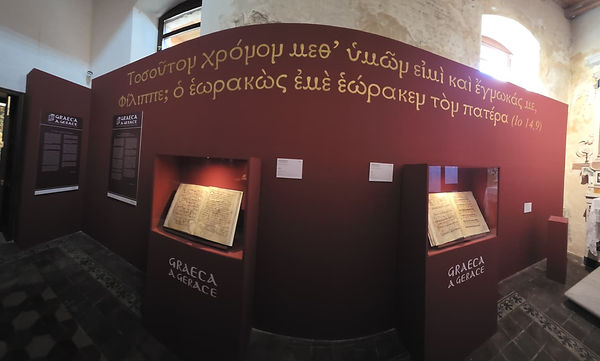
Graeca a Gerace — Celebrating Gerace’s enduring Greek and Byzantine heritage
Linguistic profile
The Griko grammar contains the three-gender-system, four-case declension (nominative, genetive, accusative and vocative), and rich verbal conjugation very much alike modern Greek. The vocabulary draws from Ancient Greek roots, and core structures remain recognizably Hellenic - evident in every day phrases such as “kalinifta” (akin to modern Greek “kalinyxta” = good night).
Scholars such as Rohlfs and Hatzidakis have argued that Griko descends directly from the ancient Greek dialects of these settlements, preserving archaic Doric elements alongside Koine Greek features. An alternative hypothesis, advanced by Morosi in the 19th century attributes the dialect primarily to medieval Byzantine migrations, with Greek refugees fleeing Ottoman advances or earlier disruptions such as the Gothic war of 535-552 BC, reinforcing an existing substrate. Genetic and linguistic evidence increasingly supports a synthesis: ancient Greek ancestry is detectable in the populations of these villages. The dialect exhibits clear continuity with Medieval Greek. By the middle ages, the region fell under loose Byzantine administration, sustaining Greek as a vernacular until Norman and subsequent Latinizing pressured accelerated language shift. Yet isolated pockets in Salento resisted full assimilation, maintaining Griko as living idiom into the 20th century. This enclave thus embodies not merely a relic of antiquity but a dynamic bridge between classical Hellenism, Byzantine Orthodoxy (later supplanted by Latin-rite Catholicism), and contemporary Italy.
This shift can be observed visiting the Basilica di Santa Caterina d´Alessandria in Galatina which is a meaningful example of Griko heritage. The exterior architecture is showing an Apulian Romanesque-Gothic facade with a rose window and carved portals.

A sweeping view down the nave, revealing how the frescoes cover virtually every face - walls, arches, and vaults - creating an immersive “visual catechism” for the faithful as if it was a Greek orthodox church.

Nave of the 14th c Basilica di St Caterina d´Alessandria in the Grico town of Galatina
Griko - classified as Italiot Greek dialect alongside with Calabrian Grecanico - is an Indo-European Hellenic variety with partial mutual intelligibility to Standard Modern Greek. The UNESCO categorizes Griko as severely endangered, with approximately 20,000 native speakers (estimated from 1980 onward) and up to 40,000 to 50,000 second-language users, concentrated primarily among the elderly. In Grecia Salentina´s roughly 40,000 inhabitants, active transmission has largely ceased in younger generations, though the Italian Law 482 formally recognizes Griko language and Griko people as historical linguistic minority.
Griko manifests in rich oral heritage of songs, poetry, and festivals. Traditional pizzica dances - with emblematic of broader Salento - interweave with Griko lyrics in ensembles such as Canzoniere Grecanico Salentino and Aramirè, blending Hellenic melodic structures with local rythms. Folklore includes proverbs, lullabies, and narratives that reference Byzantine saints and ancient myths. Cuisine reflects Mediterrinean synergies. Dishes like pitta (a Greek-style pie) and lestopitta echo Hellenic baking traditions, while Easter processions retain subtle Byzantine resonances despite Catholic observance.
Griko people view themselves as ethnic Greeks, maintaining ties to modern Greece through language study visits, cultural exchanges, and a shared sense of historical continuity.

Hidden Secrets Beneath One of
Calabria’s Greatest Hellenistic Strongholds
What lies buried under one of the most impressive fortified settlements of Hellenistic
Calabria? A recent collaboration between archaeologists and geophysicists from the
University of Catania is beginning to lift the veil—without a single invasive dig.
Castiglione di Paludi, perched in the Cosentino hills, ranks among the region’s most
remarkable ancient sites. Founded in the 4th century BC, its origins remain debated:
was it established by Greek settlers from the poleis of Magna Graecia, or by the local
Brettian peoples who controlled this territory?
Whoever its founders, the settlement grew into a carefully planned community. A
powerful and complex defensive wall enclosed it, with at least two gates on the eastern side—the northeastern one especially monumental in design. Inside, the town was laid out along a broad central avenue, the plateia, with at least one large open area set aside for public life.
Intriguing puzzle
Yet the most intriguing puzzle sits right in the middle of that main street. The remains of a heavily damaged building interrupt the plateia roughly halfway along its course. Its purpose is still unclear, but the location and character of the structure strongly suggest a public focus—perhaps one with a sacred character. Understanding this enigmatic building could help place Castiglione di Paludi more precisely within the wider transformations that marked the transition to the Hellenistic age across the western Mediterranean, a process that unfolded at different speeds and in different ways from place to place.
To explore what still lies hidden beneath the surface, a joint team from the University of Catania—archaeologists from the Department of Humanities working together with applied geophysicists from the Department of Biological, Geological and Environmental Sciences—carried out a non-invasive survey in May. Focusing on key zones along the ancient plateia where surface ruins already hint at deeper remains, the researchers used sophisticated imaging techniques to map the subsurface in three dimensions.
What they have found
What they found using two different techniques is encouraging. In the areas investigated, clear anomalies appear at shallow depths (approximately 4.9 to 6.6 feet). These features show resistivity values consistent with buried masonry or other solid structures—precisely the kind of evidence that points to archaeological remains still waiting to be understood. The results offer a detailed, scientifically grounded picture of what may lie below, giving future excavation teams a precise roadmap while leaving the site itself undisturbed for now.
These hidden anomalies bring us a step closer to reconstructing the full organization of Castiglione di Paludi and tracing how the settlement evolved through the Hellenistic period. By revealing the possible outlines of lost buildings and public spaces, the survey adds fresh pieces to a long-standing historical puzzle: the complex interplay of Greek and indigenous influences that shaped this corner of ancient Italy.
The ground at Castiglione di Paludi still holds its secrets—but they are no longer entirely out of reach.
Source: University of Catania, Sicily, Italy: Geofisica e archeologica svelano i segreti di
Castiglione di Paudi,URL: https://www.unictmagazine.unict.it/geofisica-e-archeologia-
svelano-i-segreti-di-castiglione-di-paludi.